What Are Content Pillars? How to Choose Topics That Support Your Offers
My simple content strategy is to always start with what I sell and work backwards when planning content. What questions do people have? What do they need to know or believe before they buy? The answers are my topics.
My content pillars are simply the way I group my topics together.
What Are Content Pillars?
Content pillars are the main topics or themes that all of your content can be sorted into. Think of them like themes that connect your content to your business goals and make life easier by providing a framework for everything you share so you can attract your ideal audience, earn their trust, and guide them toward becoming a customer.
A general rule of thumb is to start with three to five broad topic categories so your message stays focused and your audience knows what to come to you for.
Each of your 3-5 content pillars should represent a topic theme that’s…
- Relevant to your brand and the products and services you sell
- Relevant to your ideal audience
Each pillar can have plenty of subtopics. If “blogging for business” is one of yours, “how to choose blog post topics” is a subtopic you could turn into a guide, an email about how you make that decision, or a case study showing how you did it for a specific offer.
Content Pillar Examples
The easiest way to determine your content pillars is to just start brainstorming topics that relate to what you sell, or what you want to sell, and the things your ideal customers might have questions about.
Say you’re a digital product and course creator that helps small businesses with digital marketing. The topics you come up with might look like this…
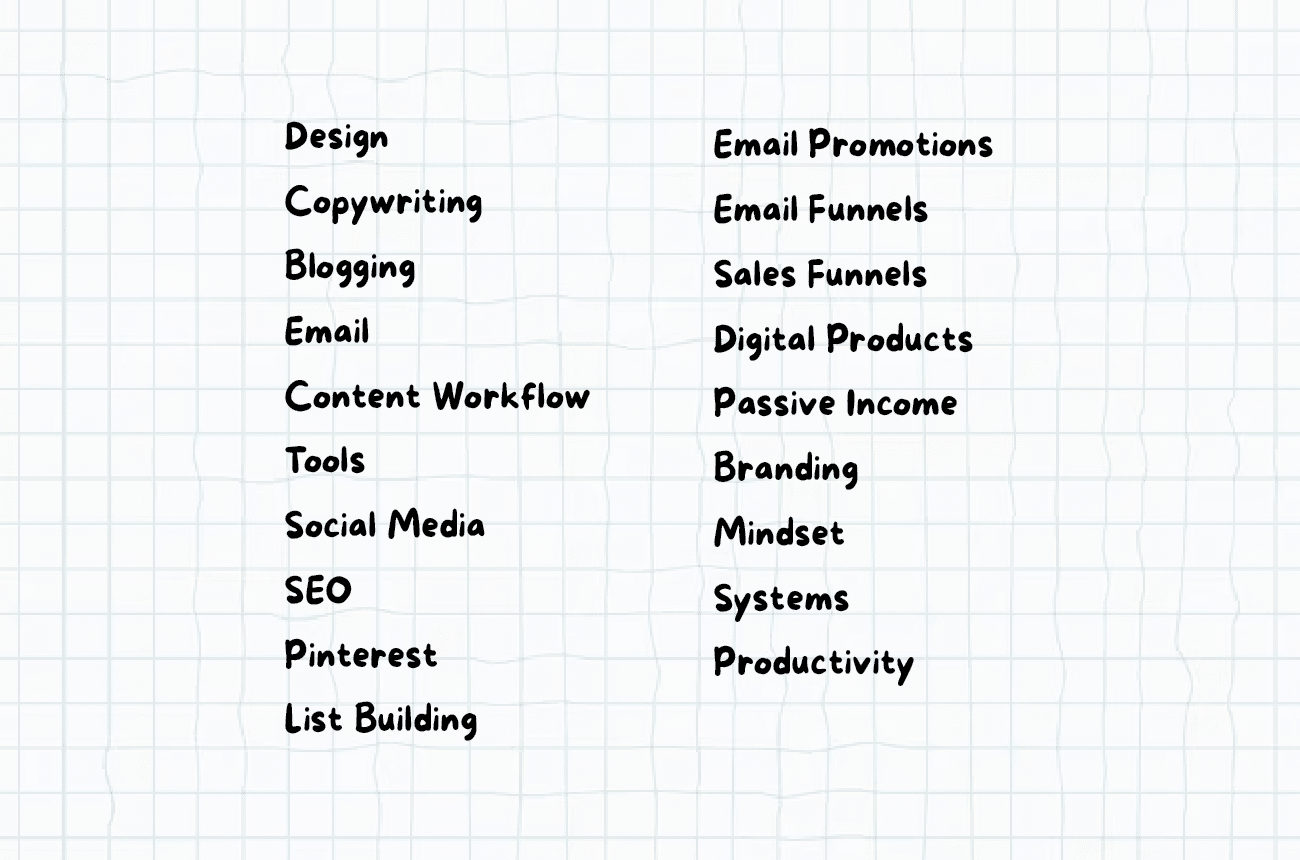
Once you’ve brainstormed your list of topics, you want to start grouping them together in common themes or “clusters.” It may take some shuffling around, but eventually you should be able to put them all under 3-5 broad topic categories.
(If you come up with 3 that’s perfect, don’t strain yourself trying to get to 5. The more you niche down, the simpler it will be to manage. But if you need 4 pillars or 5 that’s perfectly fine too.)
In this example, those main pillars might look something like this…
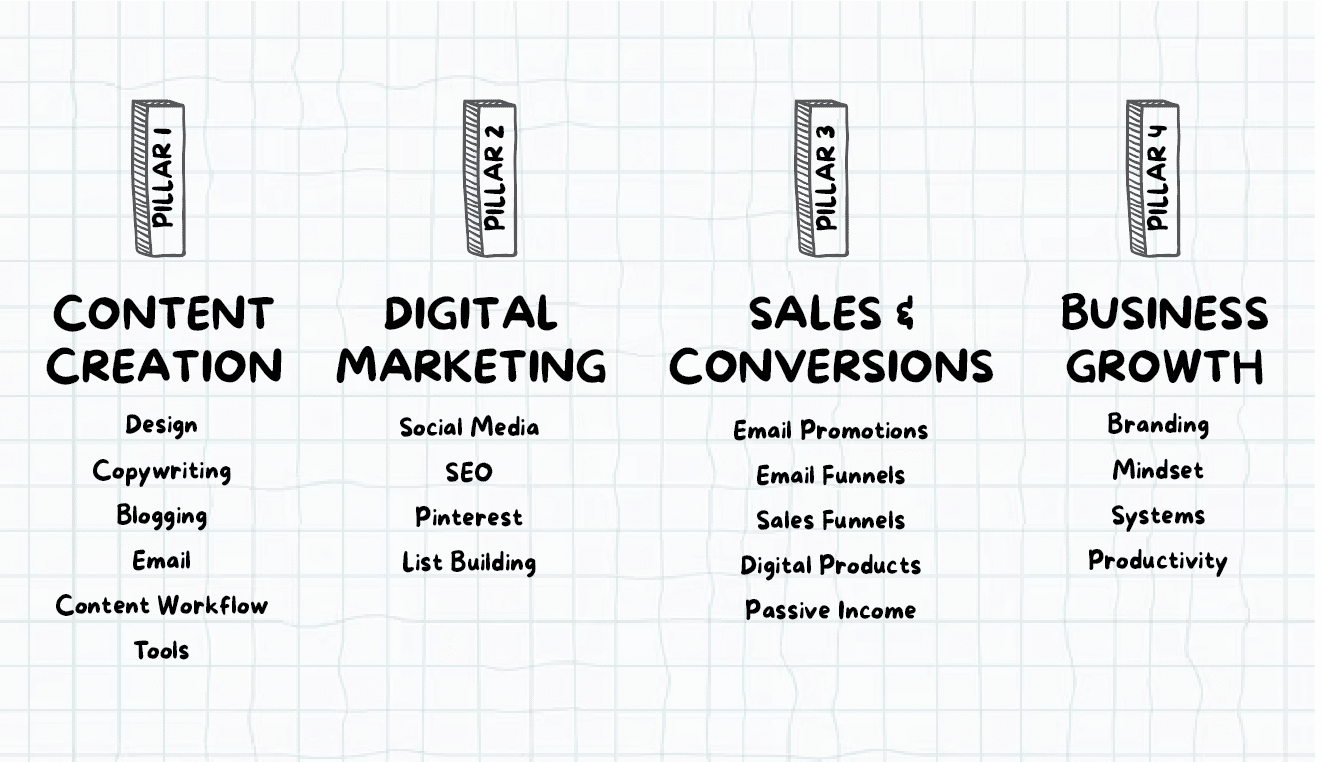
I drew this example for my previous business, where we sold products across several areas of digital marketing. Each pillar gave us a set of topics our customers cared about, and we could focus on one pillar at a time depending on what we were promoting.
You can spend plenty of time helping people with the questions that come before a purchase. If your offer helps people write sales emails, teach them how to decide what to promote, how to plan an email sequence, or how to write the last email in a sale.
Notice that each of our pillars is broad enough so we can include multiple subtopics.
From those subtopics, we have the flexibility to break them down into an infinite number of tips, personal stories, case studies, how-to guides, industry news updates, and so on and still maintain a cohesive brand story (who we help and how we help them).
Just for fun, I thought I’d show you a few more…
Content Pillar Examples for Different Niches
Let’s explore examples of content pillar topics for various niches to give you inspiration for your own business…
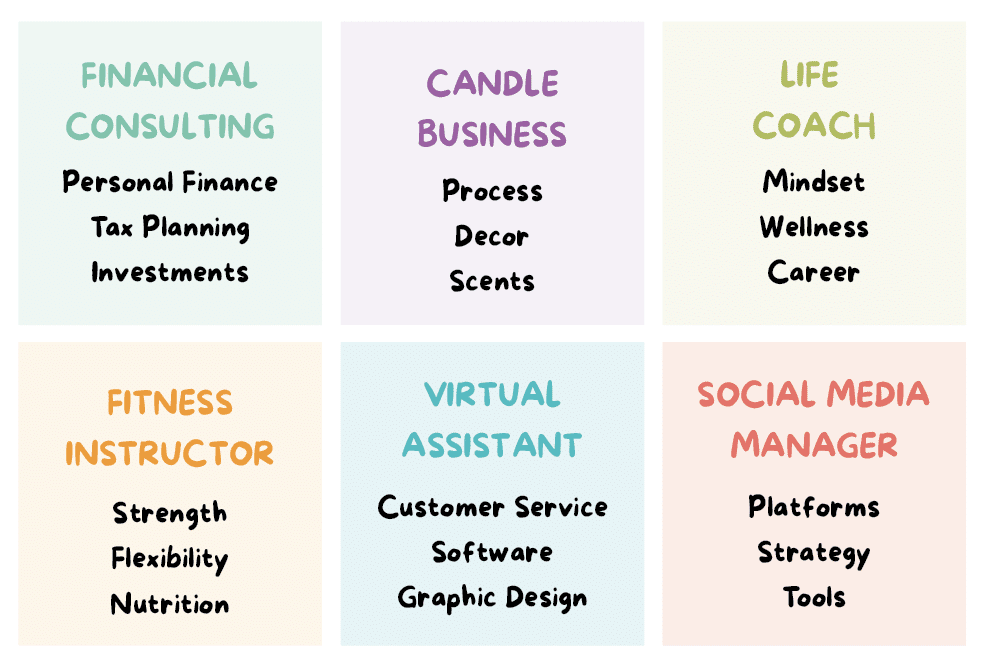
These topics are just fictional examples to get your creative juices flowing. If you see your niche here, your pillars might look completely different and that’s okay! Your pillars are unique to your business.
How to Choose Content Pillars That Support Your Offers
Pick one product or service you want your content to support. Write down who it’s for, what it helps them do, and what they usually need to figure out before they’re ready for that kind of help.
Step 1. Decide Who You’re Creating Content For
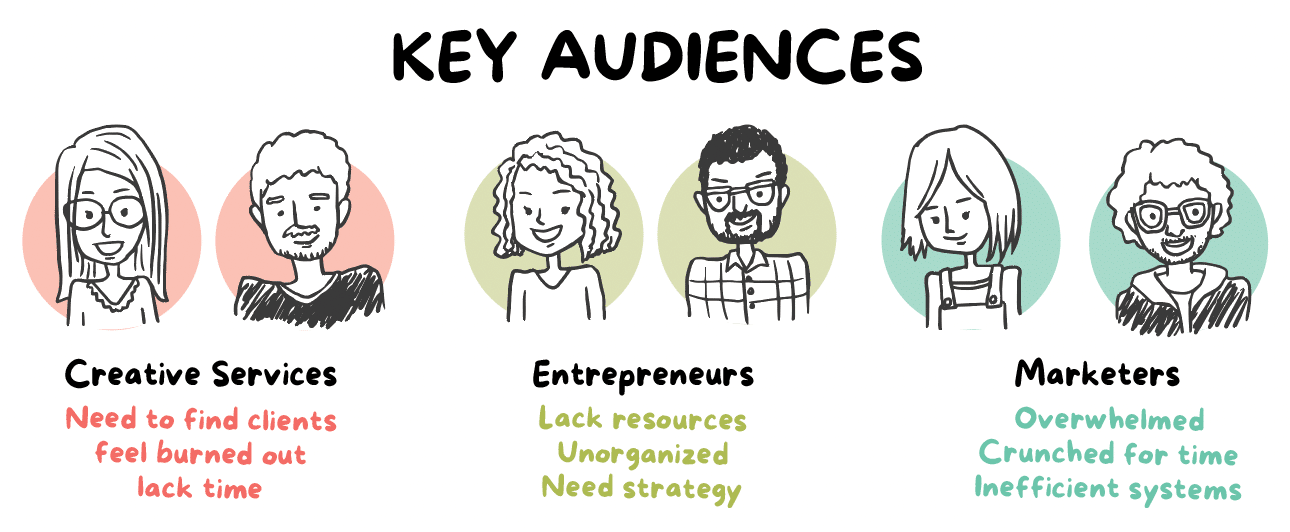
Write down the people who are a good fit for the offer, especially if you work with more than one kind of customer. A consultant who sells a positioning intensive might work with designers and copywriters, but a designer who wants to sell a strategy package and a copywriter who wants to specialize bring different questions to the table.
Step 2. Picture One Customer
Creating a customer persona (or “buyer persona”) can help you speak to one person rather than a big anonymous target audience. This will help you better connect with the people who fit this profile and make sure your content sounds natural.
Think of an actual client or customer if you can. Pull up their inquiry, your notes from the first call, or the email where they described what they wanted, and pay attention to the words they used.
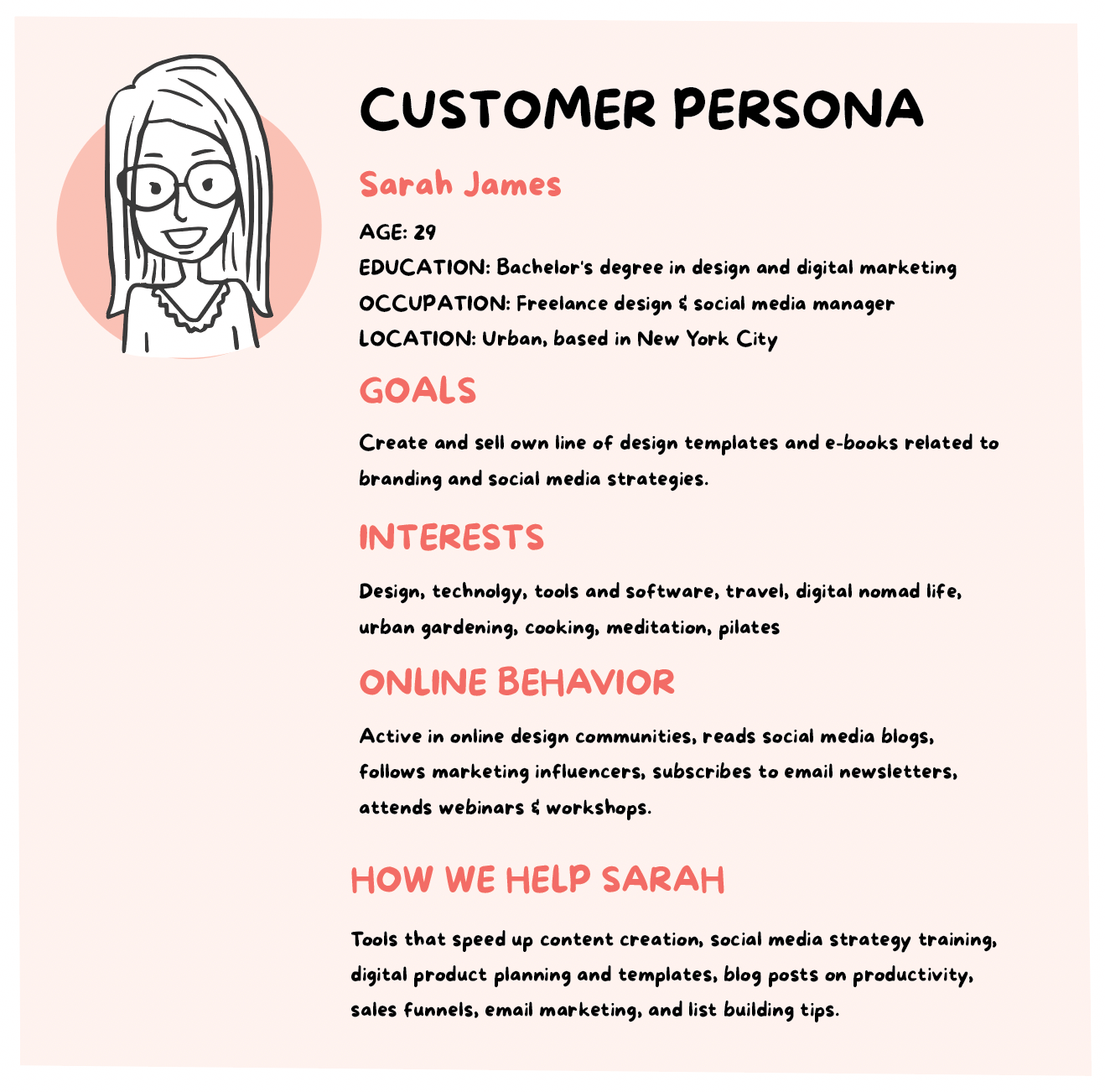
Now rather than speaking to “just anyone” we can picture Sarah and speak directly to her in our content.
Step 3. Find Out What They Need to Figure Out
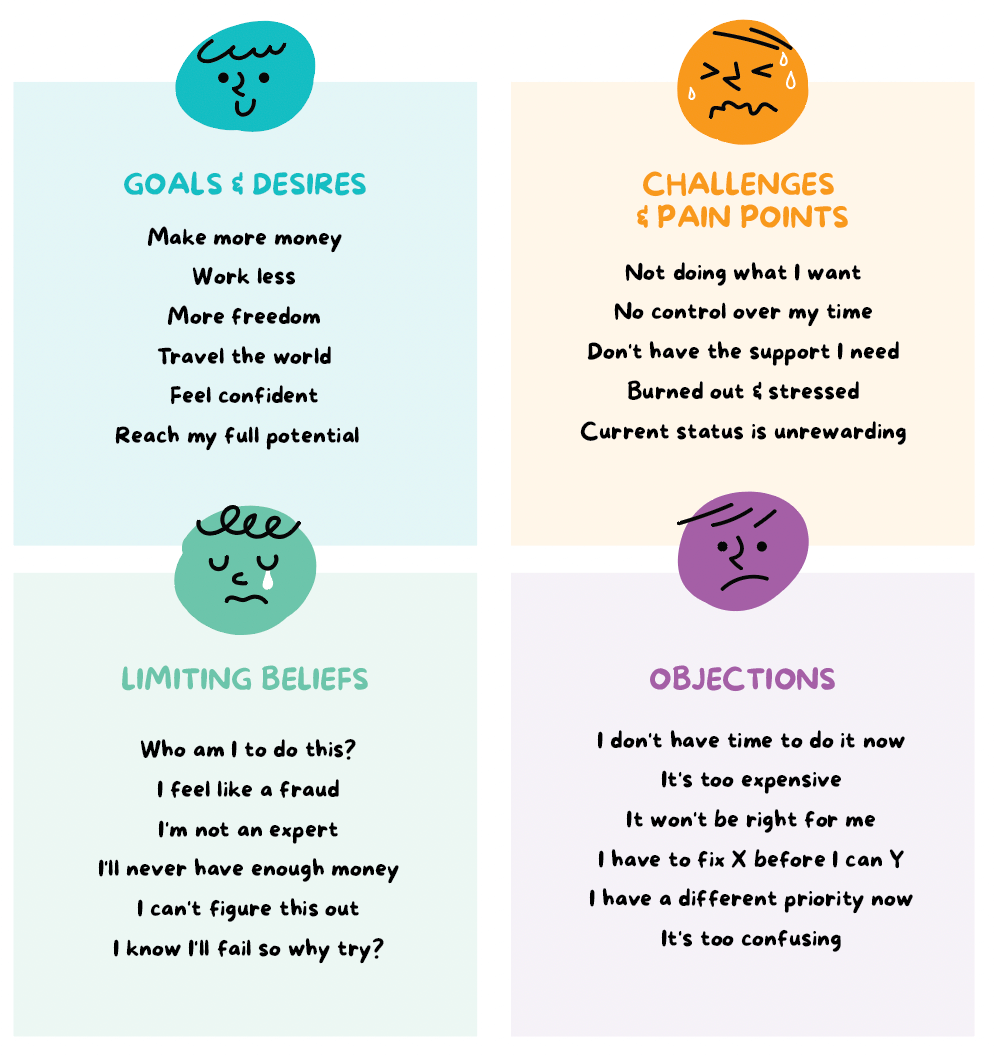
The questions I want on my list are the ones someone would ask before they knew what to buy or who could help them. Start with what you’ve heard on sales calls, in emails, or from customers while they were doing the work.
- What are they struggling with?
- What problems keep them up at night?
- What do they desire most?
- What’s standing in their way?
- What beliefs are holding them back?
- What does life look like once they get what they want?
Think of this as an “empathy exercise.” When you’re able to see things from your customer’s perspective, and you have one representational person to write content for, you’ll be able to create meaningful content for the people you want to connect with.
When you’re done, you should have something that looks like this:
Step 4. Make a List of Topics You Could Teach
Use those questions to brainstorm smaller topics you could write about. If you sell a positioning intensive, you might cover how to help people explain what you do when they refer you, how to describe what makes your service different, or how to tell when your offer is too broad.
If you want to see how people phrase related questions, try AnswerThePublic. I’d put the most useful questions on the list, especially the ones you can answer from your own work and that come up for people who are a good fit for your offer.
Step 5. Group the Topics Into Three to Five Pillars
Once you have a list of topics, group them under a few broad themes. For each group, name the offer it supports and ask yourself whether you have enough to say about it to write several useful pieces.
You might be able to talk all day about a subject, but if you can’t explain why the people who buy from you would come to you for it, take it off the list for now.
This is not set in stone.
You are allowed to change your strategy if you find that something isn’t working or if you change direction in your business.
How Content Pillars Fit Into Your Content Strategy
When I pick a topic for a post, I ask myself “What do they already know?” Someone who’s just realizing their offer is hard to explain needs different help from someone comparing two consultants who could help them fix it.
This is what marketers call the “customer’s journey” and it’s really just a fancy way of describing the process we all go through before we buy something.
In content marketing, we say that we “meet people where they are” (in this process) with our content.
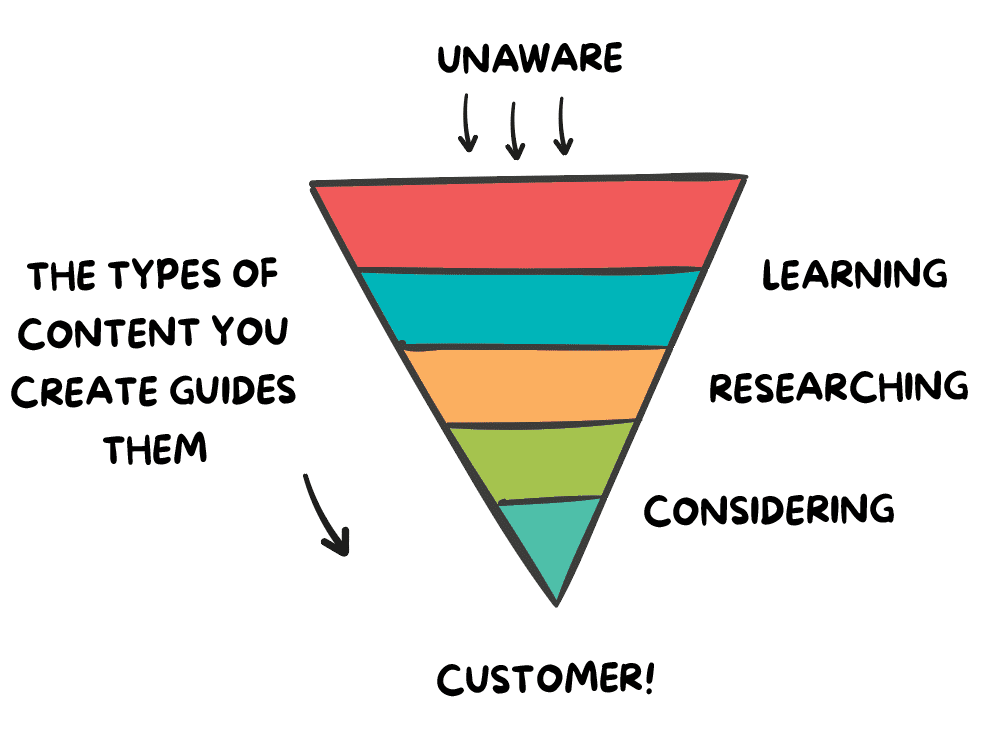
Say you help independent consultants package a service. A person who’s tired of writing custom proposals might need a post that helps them see which parts of their work they could standardize. Someone already exploring a packaged service might want to see a before-and-after example, including what went into the offer and what you left out.
Both pieces can come from the same pillar. Each answers a question the reader has at a different point in the decision.
Turn One Content Pillar Into a Plan
I like to focus on one pillar at a time when I’m getting ready to promote something. Pick the offer, choose the pillar that fits it best, and pull out a few questions people need answered before the offer makes sense to them.
For the service packaging example, I might plan three pieces in this order.
- A blog post that helps people spot the parts of their service they already deliver the same way.
- An email that walks through a real decision about what to include in a package and why.
- A case study or walkthrough that shows what the finished package looks like, with an invitation to learn about the service.
Your call to action can be as simple as pointing someone to the next article that answers their question. When the next step is to check out the offer, tell them where to go.
If you’ve picked a pillar and want to turn it into a series of blog posts that helps people make a buying decision, use my guide to building a Conversion Cluster.