Is AI Wearing You Out? You Might Have “AI Brain Fry”
Originally posted on Substack
It was November of 2025 the first time I realized I was experiencing AI brain fry.
I’d been using AI to help me with a project for weeks—processing vast amounts of information, making decision after decision, directing the AI, correcting the AI, and overseeing the AI.
I became so mentally exhausted that it actually scared me.
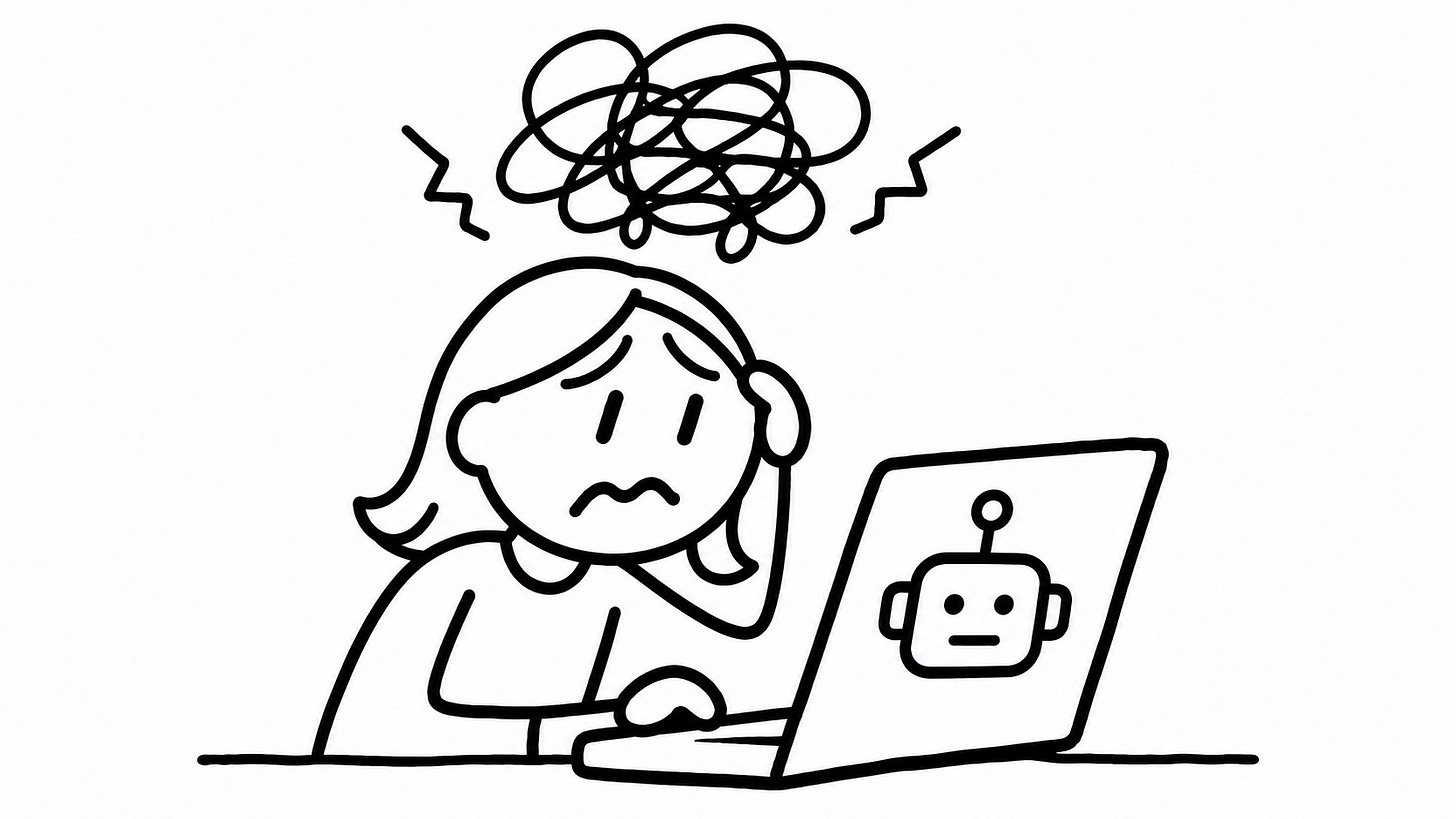
I remember standing up from my desk, cradling my brain in my hands, looking at my husband and saying, “Babe, I think AI is making me stupid.”
Because I’m quite fond of my ability to brain good, I took a few weeks off from using AI and started learning all I could about it. I wanted to know how these LLMs actually work and why they sometimes negatively impact the people who use them—causing burnout, fatigue, even psychosis.
This is not about being anti-AI or pro-AI (for the record, I’m neither of those things). I just think it’s important to have a conversation about how to use it well so at the very least, it doesn’t cause harm to humans.
Coming up…
- AI Brain Fry is Real
- Making Things & Directing Things Are Different Mental Modes
- Strategies To Try
AI brain fry is real
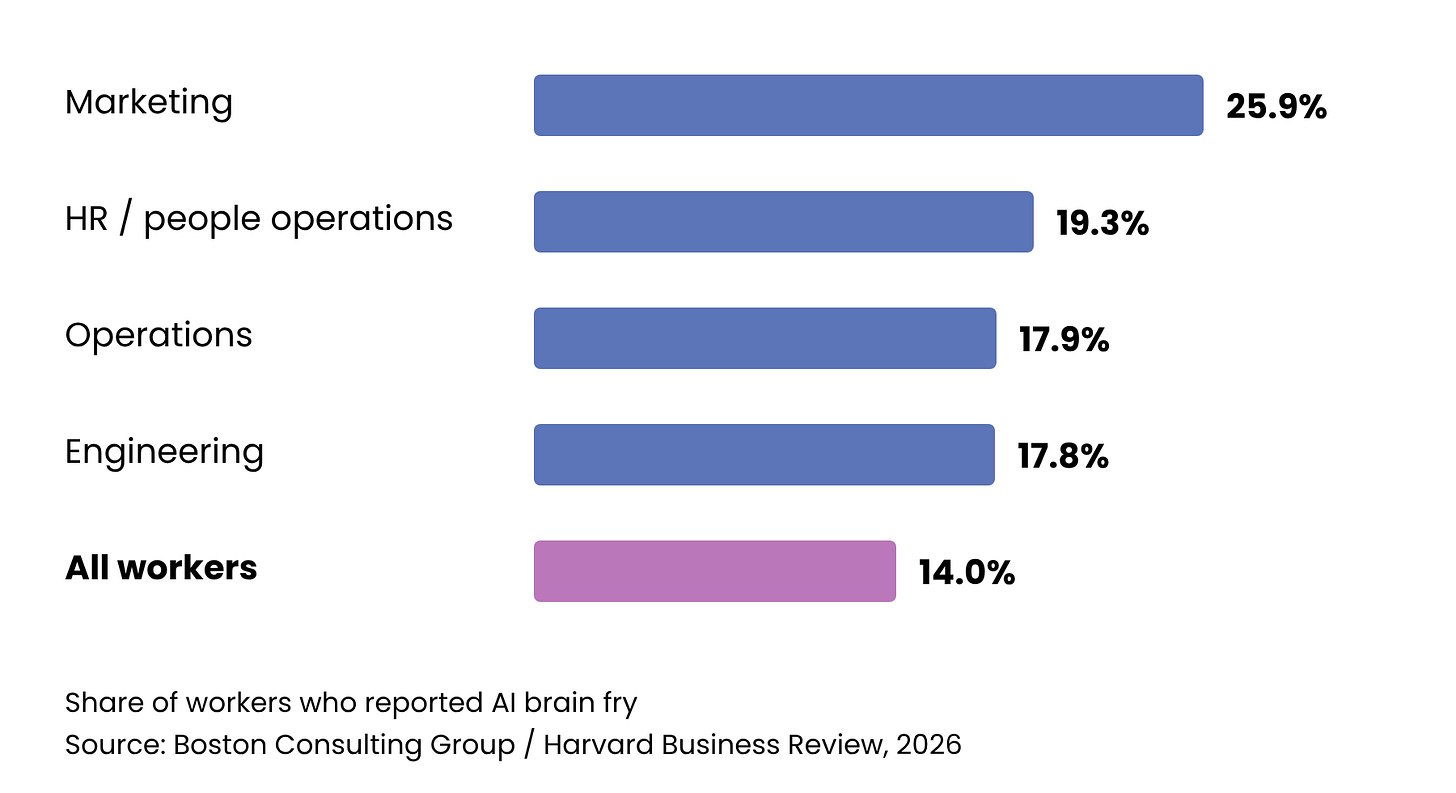
The term “AI Brain Fry” comes from a study by Boston Consulting Group published in Harvard Business Review in 2026. They surveyed 1,488 full-time workers and on average, 14% reported experiencing mental fog, difficulty focusing, slower decision making, and even headaches.
Interestingly, heavy users like marketers and HR professionals experience brain fry more than the average worker, which suggests there are different risk factors for brain fry depending on the context.
AI brain fry happens when people use, interact with, and/or oversee AI excessively and beyond their cognitive capacity.
Brain fry is different from burnout, which is emotional exhaustion. When you’re burnt out, you might fantasize about quitting your job or wishing your situation were different somehow.
AI brain fry is acute cognitive strain. It’s when your attention and working memory are pushed past their limits.

Unlike burnout, you might actually enjoy the work and even feel motivated by it, it’s just that by the end of the day your brain feels like a Blob of Goo™.
I’ve been curious about why this is because it doesn’t happen to me when I’m doing other mentally strenuous things. It turns out there’s an explanation for that.
Making Things & Directing Things Are Different Mental Modes
As a former creative professional, I understand why people hand off creative work like writing to AI: creating something out of nothing is a painful process.
It’s slow. Unpredictable. At times, even scary.
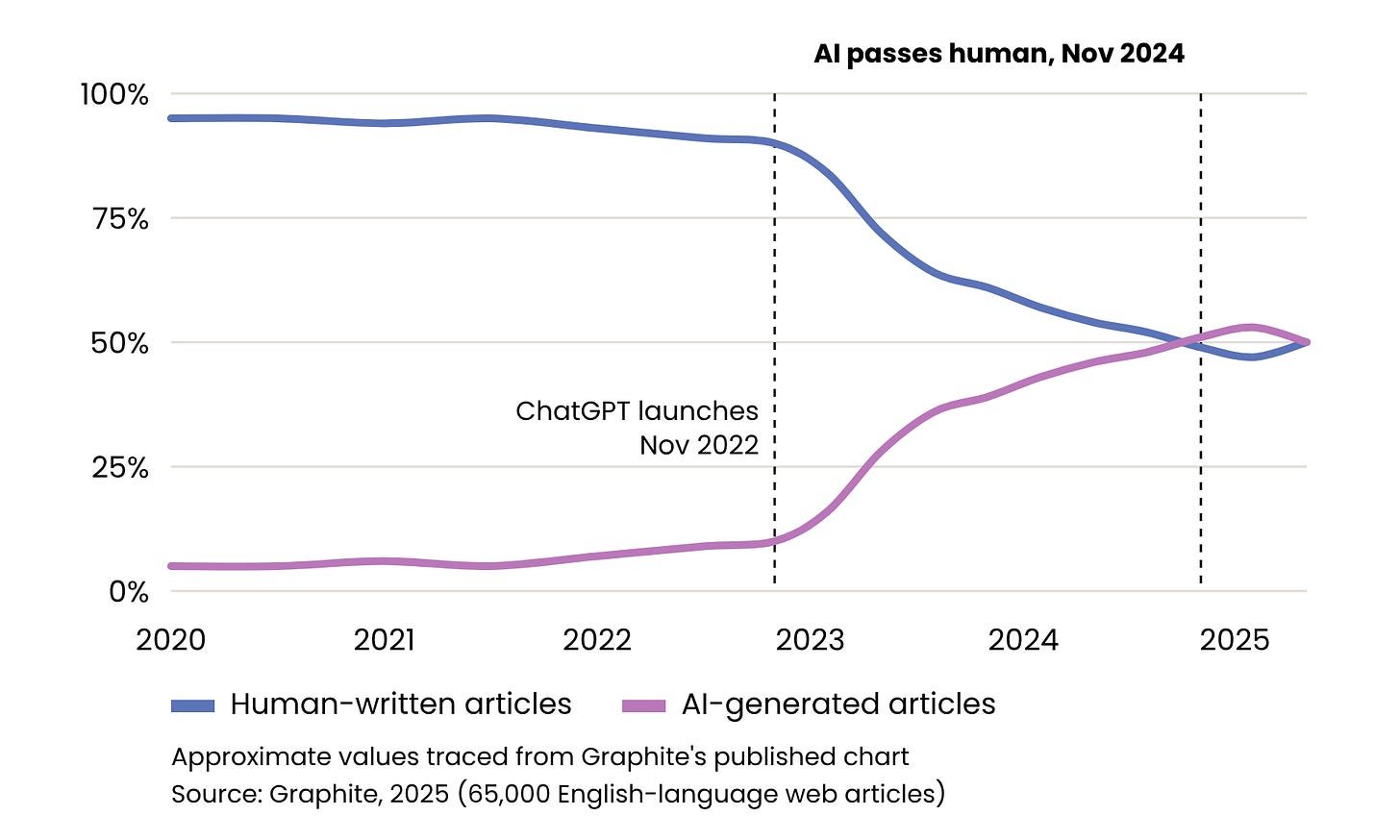
There’s nothing more terrifying than a completely blank page and most people will do anything to avoid it. Thus, the proliferation of slop all over the internet.
I grew comfortable with the blank page in my work, but the struggle was always part of it. I learned to trust the process and just keep going knowing that I would always get there.
Creatives often talk about being “in the zone,” where your brain starts firing on all cylinders and everything clicks. In this state you’re focused, enjoying the work, and not even noticing that time is flying.
When your brain is in this mode it feels amazing. It’s energizing.
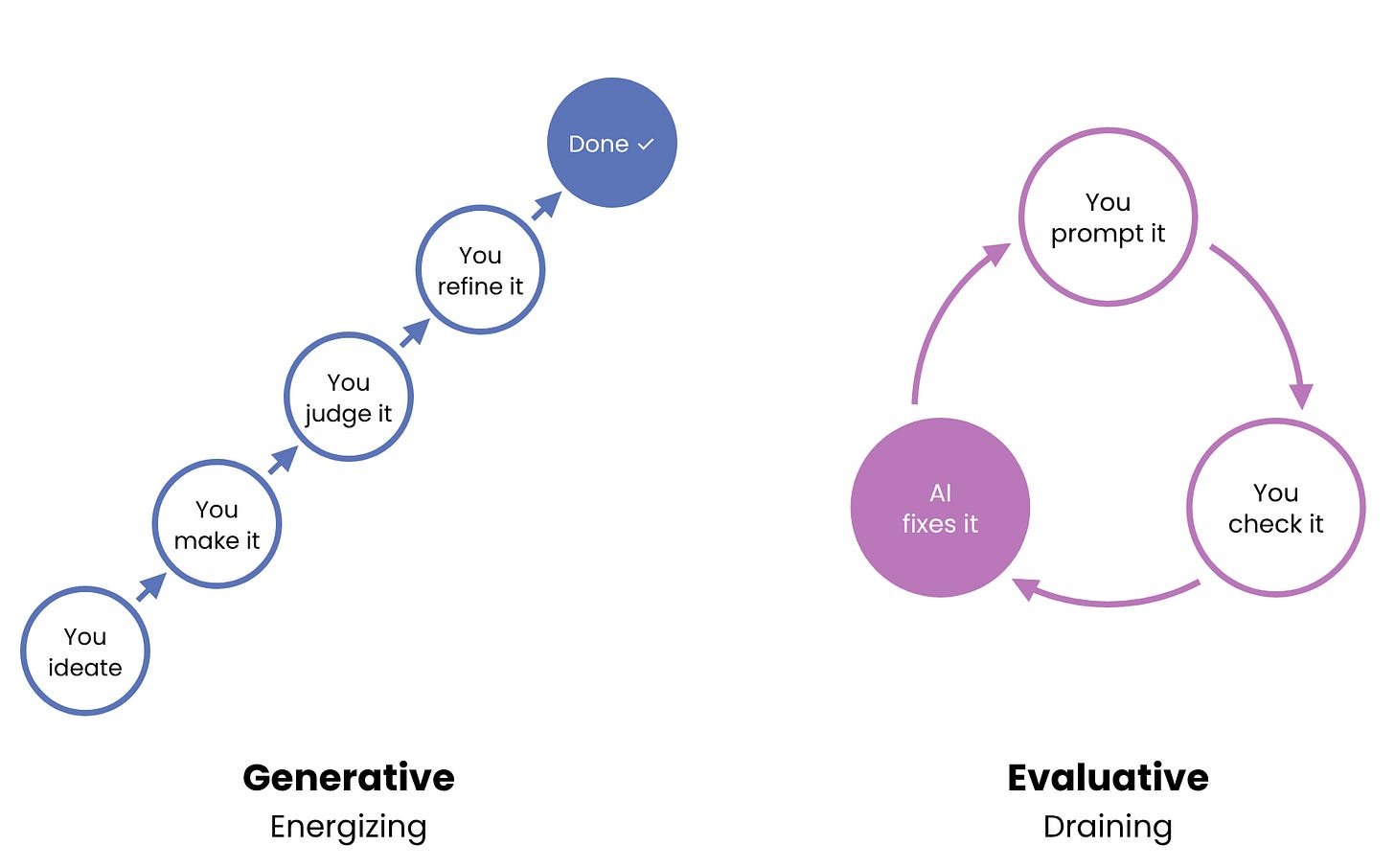
The shift between the struggle and getting into a creative state of flow is what neuroscientists call a generative state.
A generative state is an optimal neurocognitive mode where the brain shifts from passive reaction to active creation, problem-solving, and deep flow. Instead of burning energy on self-doubt or distraction, your nervous system synchronizes its networks and releases performance neurochemicals to make intense focus feel effortless and energizing.
When AI is doing the work, it disrupts this. It spits out the work and you skip the necessary struggle.
Instead of creating concepts, we’re judging concepts, and this is a completely different mental process.
You might say, well yeah but some people are creative directors, editors, managers—people whose job it is to judge others’ work. But unlike human-created output, AI never gets tired, it always goes fast, and it’s always on 24/7/365.
We might make hundreds or even thousands of micro evaluations in a day, and I would argue that this has unlocked a new level of decision fatigue for humans.
Okay. So what do we do about it?
Strategies To Try
I’m not a neuroscientist, just a person trying to figure this out. These are the things that have helped me and things I’m experimenting with.
Change how you think about AI
Let’s just call this having mental boundaries.
People get into trouble when they rely on AI to do the thinking and decision-making for them, and before I really understood how LLMs worked, I admit that I trusted it way too much myself.
After realizing that AI was frying my brain, the first thing I did was shift the way I view AI and my relationship to it.
It’s not a wizard, it’s not my smart intern, and it’s not my friend.
It’s a service that I pay for.
This is not to minimize how powerful or helpful it is, but for me, there’s something about a machine that sounds like a smart, agreeable human that I find quite dangerous. If you let it lead, it can lead you astray and take you down exhausting rabbit holes.
I do not view AI as being on my side or not on my side, I view it as a neutral thing.
It might present good ideas, it might present horrible ideas.
I now distrust everything that it generates for me by default, and this distrust puts me in critical thinking mode: I question everything and use my own reasoning and judgement to direct and evaluate the output.
Simply by shifting the way I view AI, I’m able to prevent being led down rabbit holes that are frustrating, counterproductive, and fatiguing.
The AI Sandwich Method
The idea here is to do the thinking before you touch AI.
Instead of reaching for AI first, you pull out a pen and a piece of paper (remember those?) or your notes app on your tablet and write out a game plan:
- What’s the problem you need to solve?
- What’s the goal?
- What does done look like?
Then bring in the AI to generate options and perform tasks.
Then review the work, refine, decide, make final calls.
Like a sandwich:

This warms up your thinking before using AI and brings back a bit of the necessary struggle into the process.
Time-Box Your AI Work
Set boundaries around the time you spend with AI.
Over at MindStudio they describe how AI fatigue actually happens:
Not from overwork in the traditional sense, but from a slow erosion of focus — the kind that builds up when you stop treating AI sessions as a tool you use deliberately and start treating them as an environment you just live in.
Yikes, can they see me? 👀
The time boxing method is about using timers. It’s similar to Pomodoro, but with a twist.
You decide how long you want to work on a task — say you need to draft a marketing campaign today and want to spend no more than 30 minutes on it.
Set a timer for 30 minutes and end the work when the buzzer rings.
You’re not trying to complete the task within the time you allotted, you’re committing to ending the work whether you’re finished or not.
Cap Your AI Tool Stack
Another interesting insight from the BCG study is that workers reported peak productivity when using up to three AI tools, but that started to plummet when they introduced a fourth tool.
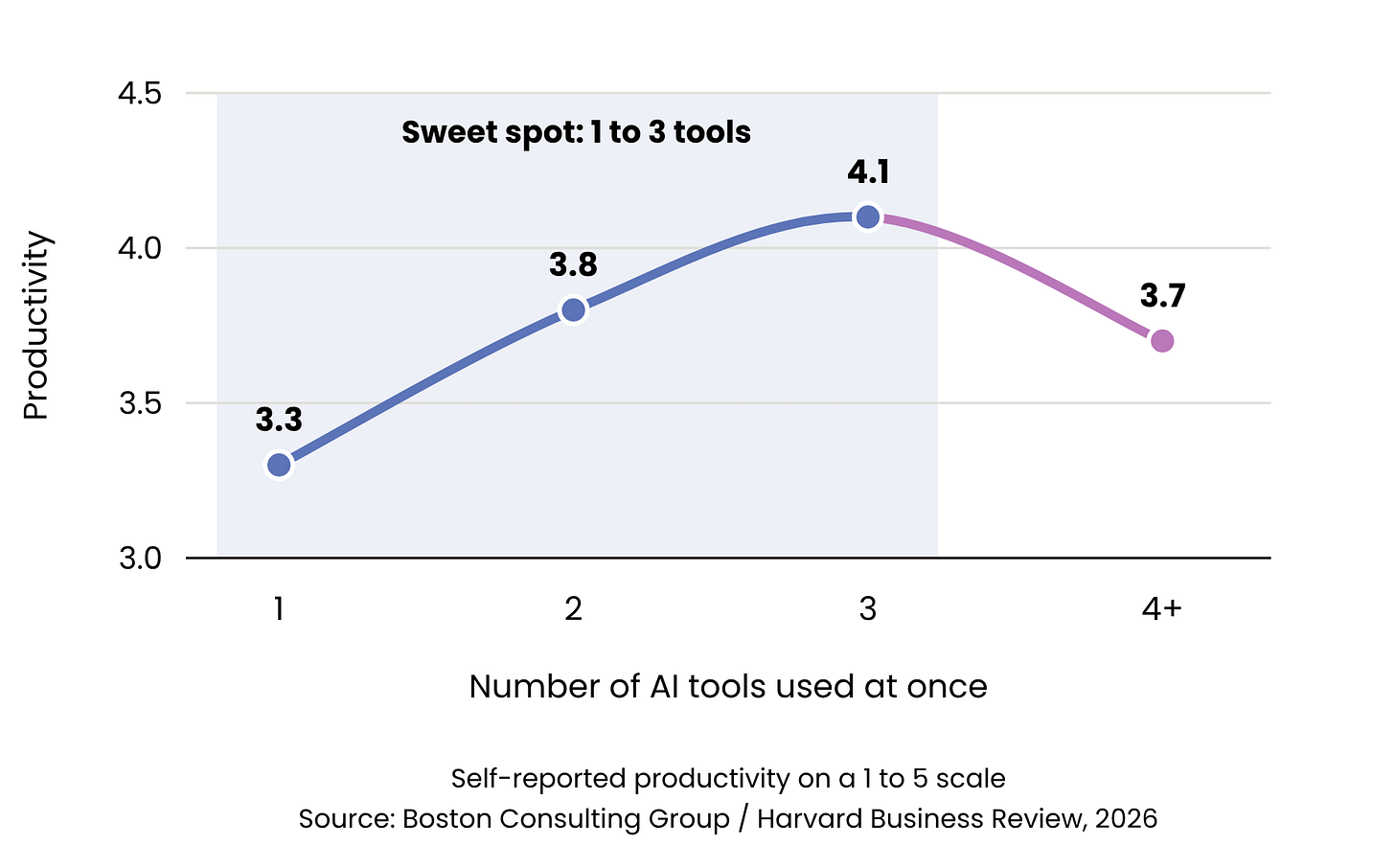
As someone who uses different AI tools depending on the task, I’m guilty of having multiple projects running at the same time. It feels like you’re being more productive by putting multiple agents to work, but it makes sense that constantly switching back and forth to supervise is cognitively draining.
I think the bottom line here is being more intentional with the amount of stuff you’re overseeing is a good thing to try if you’re experiencing exhaustion after working with AI too much.
Have you experienced AI brain fry? What are you doing to prevent it and manage it? Any strategies I’ve missed?